
Peninsula Energy Limited (ASX: PEN) is an Australian uranium company focused on the exploration, development and production of uranium in the United States. Headquartered in Subiaco, Western Australia, the company has built its strategy around its 100%-owned Lance Uranium Project in Wyoming, one of the company’s key assets and the foundation of its long-term growth plans. Peninsula Energy has a long history in the uranium sector, having been incorporated in 1993 under the name Peninsula Minerals Limited before adopting its current name in November 2010. Its focus on the U.S. uranium market provides exposure to a jurisdiction with established nuclear infrastructure and growing interest in domestic uranium supply.
The Lance Project is being developed using in-situ recovery (ISR) technology, which involves extracting uranium through wells rather than conventional open-pit or underground mining. This approach can potentially reduce surface disturbance and provide a scalable pathway for uranium production. Peninsula has been working to advance the project toward sustained production while continuing to optimise operations, expand resources and strengthen its development platform. The company’s future performance is therefore closely linked to the successful ramp-up of Lance, operational execution, uranium prices and the broader demand outlook for nuclear energy. With uranium remaining a strategically important fuel for the global nuclear industry, Peninsula Energy offers investors exposure to a U.S.-focused uranium development story, with potential growth dependent on converting its resource base and project infrastructure into reliable, commercially sustainable production.
Stock Overview — Key Metrics
Metric | Value |
|---|---|
Risk | Low to Medium |
Market Cap ($) | $160.02m |
Shares Outstanding | 571.53m |
Beta | 0.2527 |
EPS (TTM) | -0.0993 |
P/E (TTM) | — |
Dividend Yield (%) | — |
52-Week Range ($) | $0.225 – $1.075 |
Target Price ($) | $0.425 |
Stop Loss ($) | $0.180 |
Stock Performance Profile
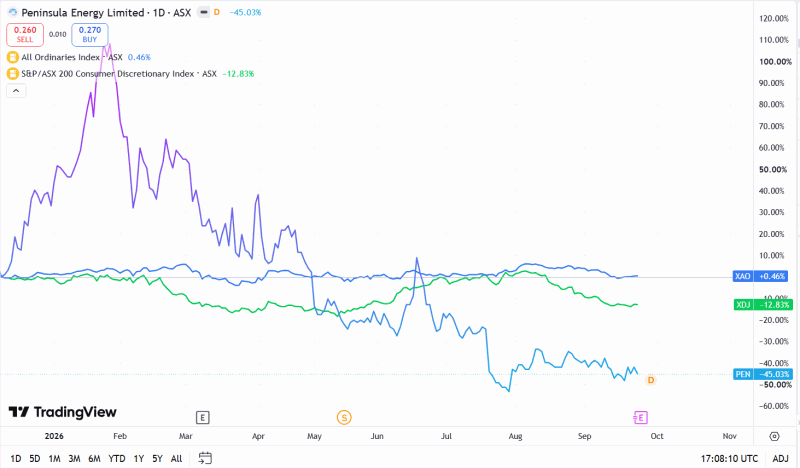
Source: TradingView
Financial Summary
Key Items | FY23 | FY24 | FY25 | FY26 |
|---|---|---|---|---|
Revenue ($m) | 25.748 | 56.843 | 16.695 | NA |
EBITDA ($m) | 0.661 | (0.177) | (19.063) | NA |
Net Income ($m) | (6.521) | (4.984) | (17.464) | (17.580) |
Financial Strength
Key Items | FY23 | FY24 | FY25 | FY26 |
|---|---|---|---|---|
Current Ratio | 8.8x | 20.6x | 0.8x | 5.2x |
Total Liabilities/Total Assets | 17.2% | 13.1% | 18.5% | 17.8% |
Source: Company filings and historical analysis
The company’s reported financial results over FY23–FY26 reflects high revenue volatility, persistent net losses and a significant deterioration in operating profitability in FY25, although the balance sheet still show relatively moderate leverage. Revenue increased sharply from $25.748 million in FY23 to $56.843 million in FY24, representing growth of approximately 121%, before falling by around 71% to $16.695 million in FY25. Revenue for FY26 is not available, limiting assessment of the latest operating trajectory.
The substantial fluctuation in revenue suggests that the business remains exposed to project timing, customer concentration, contract cycles or other factors affecting the recognition of sales. EBITDA was positive at $0.661 million in FY23, but declined to a loss of $0.177 million in FY24, before deteriorating dramatically to negative $19.063 million in FY25. This indicates a substantial weakening in underlying operating economics, with FY25 EBITDA equivalent to roughly -114% of revenue, compared with a positive margin of approximately 2.6% in FY23. The magnitude of the FY25 EBITDA loss indicates that the decline in revenue was accompanied by significant operating-cost pressure, impairment or other operating charges, rather than being solely a top-line issue. Net losses remained substantial throughout the period, improving from $6.521 million in FY23 to $4.984 million in FY24, but then widening sharply to $17.464 million in FY25 and $17.580 million in FY26. The FY26 loss is particularly significant because it exceeds the FY25 revenue base reported in the dataset, although the absence of FY26 revenue and EBITDA prevents calculation of a meaningful FY26 net margin.
Peninsula Energy did not earn meaningful commercial revenue in the financial year ending June 2026 due to severe operational delays and commissioning challenges during the ramp-up phase of its Lance Uranium Project.
Key Reasons for the Lack of Revenue
Slower-than-Expected Wellfield Ramp-Up: Throughout FY26, the company encountered persistent low-pH in-situ recovery (ISR) hurdles, particularly relating to reduced solution flow rates and leach chemistry refinement. Guidance Withdrawal: The operational disruptions became severe enough that in July 2026, Peninsula Energy officially withdrew its entire calendar year 2026 production target of 400,000 to 500,000 pounds of U3O8. Specific Mine Unit Issues: Technical setbacks were heavily concentrated in Mine Unit 1 (MU-1), Mine Unit 3 (MU-3), and early header houses in Mine Unit 4 (MU-4), preventing the plant from building the required volume for full-scale commercial deliveries. Plant Maintenance and Commissioning: The company had to pause or restrict flow multiple times to address commissioning hurdles, gassing challenges, fluid balance corrections, and component repairs, resulting in minimal final dry yellowcake production for sale.
Overall, profitability remains the principal financial weakness, with the company yet to demonstrate sustainable earnings generation. From a balance-sheet perspective, the current ratio improved from 8.8x in FY23 to 20.6x in FY24, suggesting a very strong short-term liquidity position at that point, but subsequently fell sharply to 0.8x in FY25, suggesting that current liabilities temporarily exceeded current assets and creating a potential working-capital pressure point. The ratio recovered to 5.2x in FY26, materially strengthening short-term liquidity and suggesting a substantially improved ability to meet near-term obligations. Total liabilities relative to total assets remained comparatively contained, moving from 17.2% in FY23 to 13.1% in FY24, before increasing to 18.5% in FY25 and 17.8% in FY26. Despite the deterioration in profitability, this ratio indicates that liabilities account for less than one-fifth of total assets, suggesting that balance-sheet leverage is not the primary source of financial risk. The combination of relatively moderate liabilities and a recovered FY26 current ratio provides some financial resilience; however, continued net losses and the severe FY25 EBITDA deterioration remain material concerns. The key priorities for improvement are restoring revenue consistency, controlling operating expenditure, reducing cash burn and converting the improved liquidity position into sustainable operating profitability. Until revenue visibility and EBITDA performance improve materially, the company’s financial profile remains characterised by stronger balance-sheet metrics than its earnings performance would suggest.
Despite the short-term revenue setback in FY26, management maintained its calendar year 2027 production target of 500,000 to 600,000 pounds of U3O8, signaling confidence that these execution delays are temporary operational bottlenecks rather than a fundamental flaw in the Lance Project.
Industry Overview
Exploration activity has remained volatile over the past few years because of fluctuating commodity prices and inflationary pressures. Supply chain disruptions influenced by the pandemic elevated commodity prices, spurring drilling activity to its peak of over 12.5 million metres drilled in 2021-22. However, as commodity prices softened and inflationary pressures mounted, the appetite for exploration activity has dampened, causing drilling activity to retreat from its peak and slump over the three years through 2024-25. However, this is on track to rise substantially in 2025-26. While drilling prices have plunged over the past two years, inflationary pressures, influenced by labour shortages and supply constraints, have lifted input costs. This has constrained exploration expenditure declines since 2022-23, even as activity remains subdued.
According to the World Nuclear Association, despite holding around 28% of the world's identified uranium deposits, Australia accounted for only 7.6% of global uranium production in 2024, making it the fourthlargest producer. Australia's reserves include the world's largest uranium orebody, located at Olympic Dam in South Australia. The site primarily produces copper, with gold and uranium harvested as byproducts. Currently, the mine, operated by BHP, can produce 4,600 tonnes of uranium, dwarfing that of Four Mile, operated by Heathgate and Honeymoon, the recently restarted mine owned and operated by Boss Energy. Although domestic production is below 2020-21 levels, a surging world price of uranium has provided uranium miners with much-needed growth, elevating revenue at an annualised 16.2% over the five years through the end of 2025-26, including a 31.1% spike in the current year to reach $1.6 billion.
Source: IBISWorld
Risk Analysis
Peninsula Energy Ltd’s key risks remain concentrated around the operational execution and ramp-up of its Lance uranium project in Wyoming, where delays, lower-than-expected wellfield performance, commissioning issues and production variability could constrain volumes and cash generation. The company is also exposed to uranium-price volatility, cost inflation, permitting and regulatory requirements, equipment reliability, water-management and environmental risks, as well as potential funding requirements if the production ramp-up takes longer or requires additional capital. Given its relatively small production base, operational disruptions can have a disproportionate impact on financial performance. The company’s recent quarterly reporting still be important for assessing production consistency, cash usage and progress toward sustainable operations.
Outlook
Peninsula Energy’s medium-term outlook is closely linked to its ability to stabilise and scale Lance production and convert its uranium resource and existing infrastructure into reliable operating cash flow. The company has exposure to the supportive long-term uranium market and the strategic importance of US-based uranium supply, while its operational reset and financing measures provide a platform for further development; however, the investment case remains highly dependent on showing consistent production and controlling operating costs rather than simply on higher uranium prices. Progress in wellfield performance, processing capacity, production volumes, realised uranium prices and liquidity will therefore be the principal indicators for The business outlook. If operational execution improves, higher uranium prices could provide meaningful revenue and margin leverage; conversely, further delays or production shortfalls could prolong cash consumption and increase financing or dilution risk.
Historical Forecast and Assumptions
Peninsula Energy Ltd. was expected to deliver a significant improvement in FY27 as the Lance Uranium Project in Wyoming moves toward higher utilisation of its low-pH ISR operations, with CY2027 production guidance reaffirmed at 500,000–600,000 lbs of U?O?. Assuming production of approximately 550,000 lbs and an average realised uranium price of around $90/lb, broadly consistent with uranium prices near $90/lb in September 2026, uranium revenue could reach approximately $49–50 million. With FY26 affected by slower-than-expected wellfield ramp-up, FY27 should benefit from improved flow rates, greater contribution from Mine Unit 4, owner-operated drilling and operational learning, although wellfield performance and production ramp-up remain key risks. The additional $56 million funding package provides liquidity to support development and ramp-up activities. Accordingly, FY27 revenue is forecast at approximately $45–55 million, with EBITDA potentially moving into positive territory at around $8–15 million as production scales, while net loss could narrow substantially or approach break-even, depending on uranium pricing, ramp-up efficiency, financing costs and development expenditure; successful achievement of the 500,000–600,000 lb production target would therefore represent a major step toward sustainable operating cash generation.
Technical Analysis
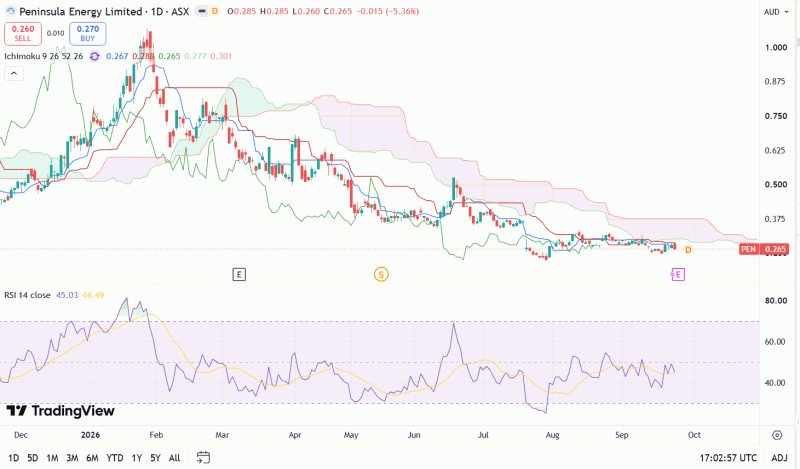
Source: TradingView
Peninsula Energy’s outlook is improving as the Lance Uranium Project moves toward higher production and utilisation. The CY2027 target of 500,000–600,000 lbs of U?O?, underpinned by additional funding and operational improvements, provides a potential pathway toward stronger revenue, positive EBITDA and reduced cash consumption. A supportive uranium price environment could further enhance margins and cash flow. However, the investment case remains execution-driven, with wellfield performance, production rampup, operating costs and liquidity requiring close monitoring. Successful delivery of production targets could materially strengthen Peninsula’s transition toward sustainable operating cash generation. After witnessing a steep decline over the past year, the stock has started consolidating near a major support zone, suggesting a potential stabilization and early recovery phase. Price action has shifted into a sideways-to-positive formation following the prolonged corrective trend, with selling pressure appearing to moderate. The stock still hold above its crucial support area, suggesting downside exhaustion. Momentum indicators, including RSI and MACD, are showing signs of stabilization, while the Ichimoku Cloud indicates improving momentum. A sustained breakout from the current consolidation range could trigger a meaningful reversal and renewed upside in the coming sessions. the original research recommended a “BUY” in the stock at cmp $0.265 (at closing rates of 23rd September 2026) keeping stop loss of $0.180 and target of $0.425.
This page adapts a historical research document and retains the original report date, company data and contemporaneous views. Market prices, financial information, forecasts, targets, stop-loss levels and recommendations may be outdated and have not been independently verified or updated by Sharesrise. References to research opinions are descriptions of the historical source, not newly issued Sharesrise recommendations.
This material is general information only and does not take account of any individual’s financial objectives, situation or needs. Securities, particularly smaller-capitalisation companies, involve substantial risk, including loss of capital. Past performance is not a reliable indicator of future performance. Seek appropriate professional advice and review current ASX announcements before making decisions. Sharesrise must obtain legal/compliance approval of this disclosure and the report rights before public release; this text does not assert an AFSL, CAR or other authorisation.